CONNECT
Grant only the systems, signals, and actions this workflow needs.
WATCH. UNDERSTAND. APPROVE. RECOVER. VERIFY.
SAIOS Loop begins with an independent evidence layer for critical websites and services. A native private Alpha is running now: it observes, records incidents, verifies recovery, and prepares bounded recommendations. Provider-neutral diagnosis and permissioned recovery are the next stage—not current claims.
THE PRODUCT / REAL OBSERVATIONS
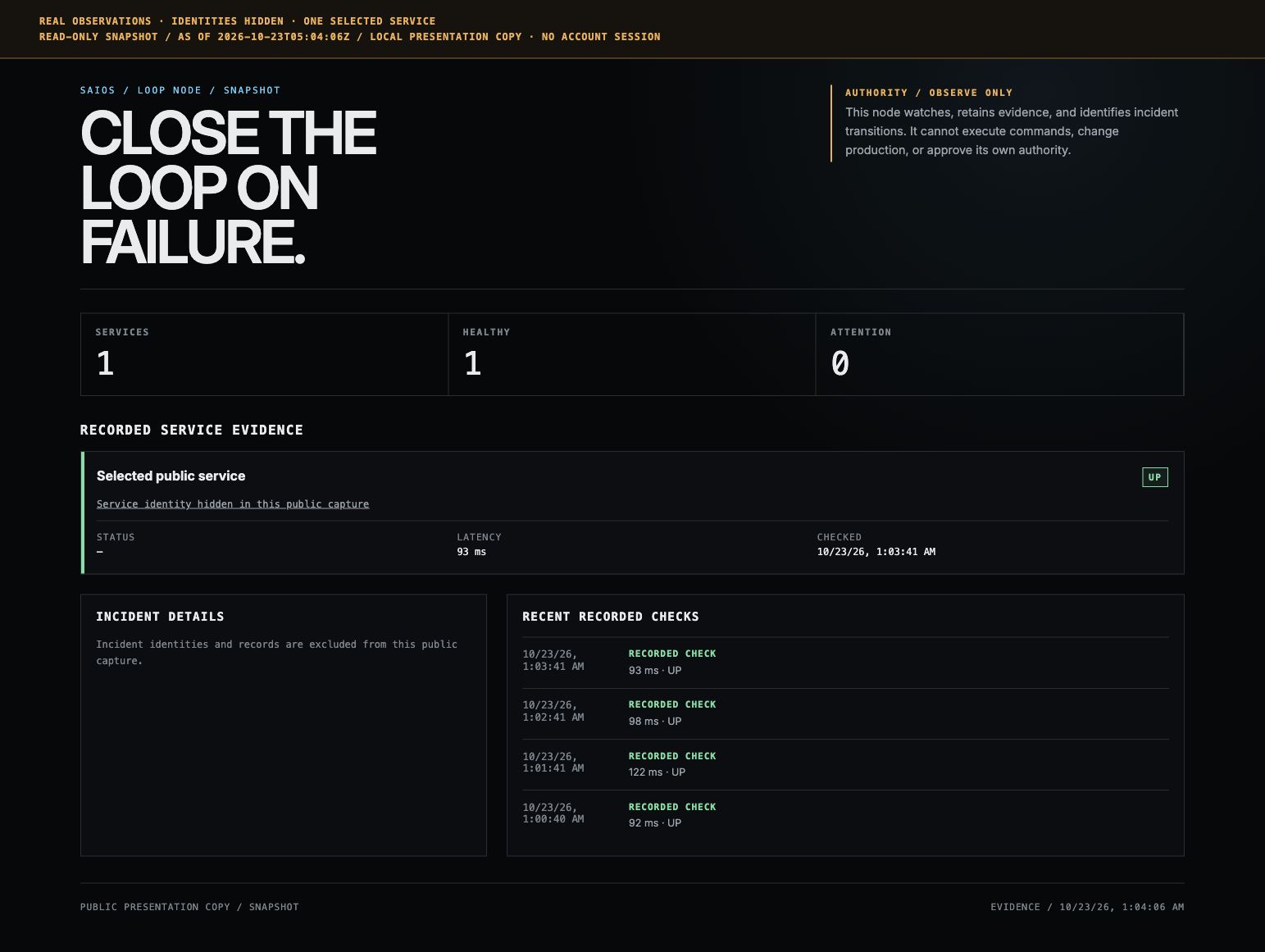
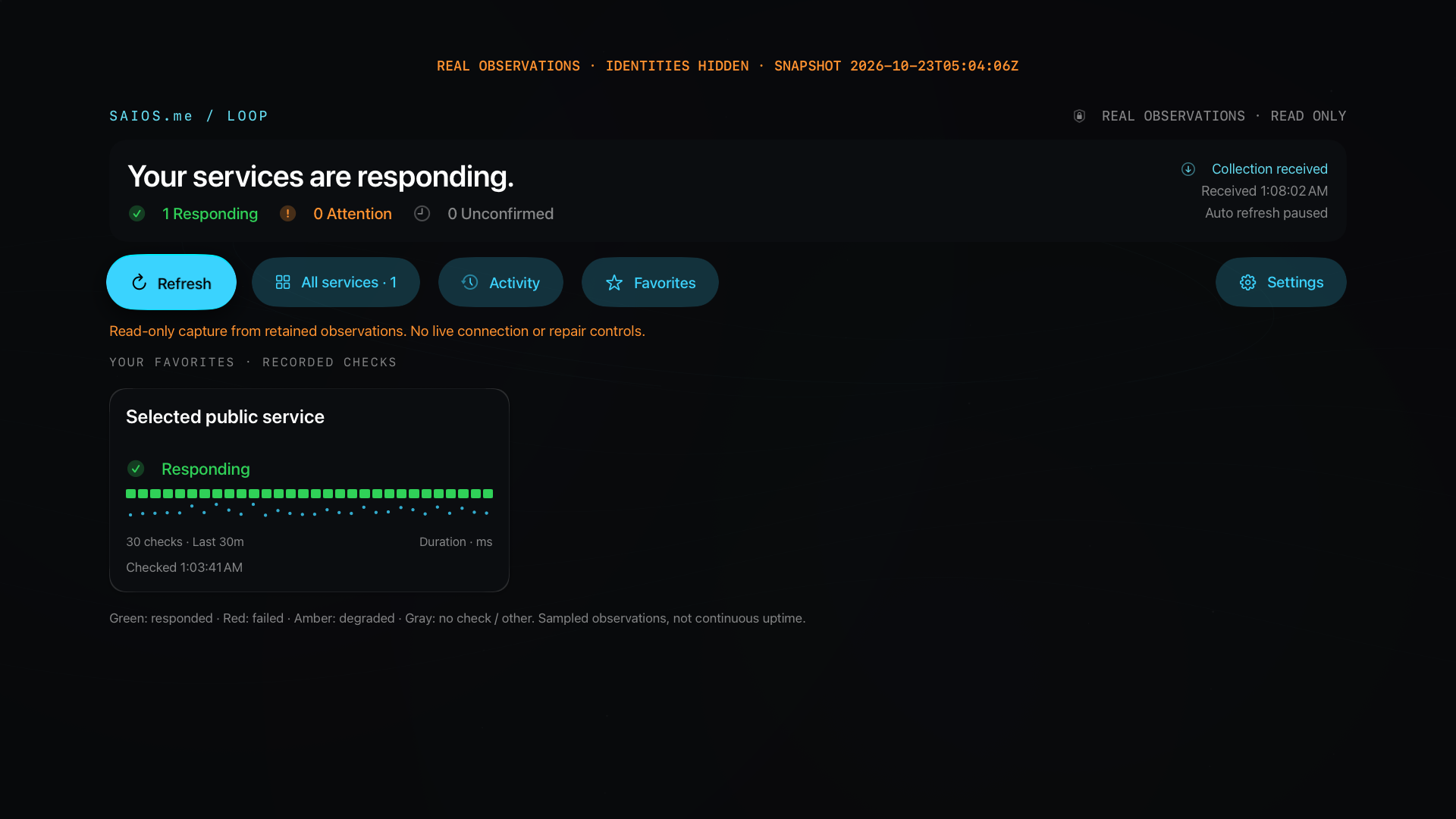
The web console and Apple TV app show the same real monitoring observations with anonymous labels. The screenshots capture a moment. The live view below keeps checking in.
ONE MONITOR / LIVE READ-ONLY VIEW
Explore the response history and check results for one real monitored service. Select a check to inspect its recorded time and response.
DEMO SERVICE 01
Connecting
One real service.
A view into its health.
The chart will appear when the first real observations arrive.
This public view contains only timestamps, check results and response times for one service. Network addresses, service names, accounts and private incident details stay on the monitoring system.
The AWS-hosted private Alpha watches 18 public services, records what changed, opens incidents after confirmed failures, and closes them only after the endpoint passes its recovery check. It can recommend; it cannot execute or approve a change.
Outside-in HTTPS checks from a network independent of the service being watched.
Two confirmed failures open a durable incident instead of turning one network miss into a crisis.
The incident closes only after the service is observed working again.
Bounded proposals remain separate from execution and require accountable human authority.
Every workflow declares what may be observed, what actions are allowed, what requires approval, how success is verified, and how the system returns to a known-good state.
Grant only the systems, signals, and actions this workflow needs.
Collect outside-in checks, system telemetry, analytics, and change history.
Correlate evidence and state what is known, uncertain, and affected.
Recommend the smallest reversible response and show its verification plan.
Require the accountable person where policy, risk, or consequence demands it.
Execute only within the declared authority and preserve a complete audit trail.
Prove recovery from the user’s point of view—not merely that a command ran.
Return to the last known-good state when recovery does not hold.
Planned adapters let a customer choose the model, cloud, data sources, and operator surfaces that fit their environment. The capability contract stays portable even when a provider changes.
A tool-neutral workflow layer designed for ChatGPT and Codex, Claude, Amazon Quick, Grok, local models, and future providers.
Focused iPhone, iPad, and Apple TV views for alerts, incident context, approvals, and shared operational awareness.
A read-only signal adapter that can correlate experience and traffic changes with incidents without replacing operational telemetry.
An inspectable plugin for status, approvals, local diagnostics, and operator workflows on an Omarchy workstation.
A locally controlled platform where Loop can place approved observation and execution close to private systems and data.
The license, trademark policy, contribution terms, and split between public and managed capabilities remain explicit founder decisions.
Read signals and retain evidence.
Explain the issue and prepare a recovery plan.
Future playbooks may run only after authority, reversibility, and verification are proven.
Escalate production, destructive, uncertain, or representational decisions.
The product now has a name: SAIOS Loop. Its open-source boundary, license, and first public contribution model are being designed now. The native private Alpha is already running while that foundation is designed and tested.